Shopify Plus Alternatives in 2026: An Honest Guide With Real Costs
Summarize this article with


The short answer. If you run a D2C brand under about $10M GMV, Shopify Plus is probably still the right platform and most "alternatives" will cost you more. BigCommerce's Performance tier is the closest like-for-like SaaS swap. Adobe Commerce and Salesforce Commerce Cloud fit large, complex catalogues with the budget for an integrator. commercetools and Saleor fit teams that want to own a composable stack. OroCommerce fits B2B-first manufacturers and distributors. And if the problem is really the app stack or running many stores, not the storefront, you may not need to replatform at all.
The rest of this guide shows the working behind that answer.
Who wrote this, and why you should read it with that in mind
Nearly every article ranking for "Shopify Plus alternatives" is written by a company that sells one of the alternatives, or sells the migration to it. This one is too. Omnislice is a commerce operations platform, and it appears on this list.
So here is how we tried to make it useful anyway:
- Every price is dated and sourced. Where a vendor publishes a number, we use it. Where it doesn't, we say the figure is reported and name the kind of source.
- We include the case for staying. For a large share of the people searching this phrase, the honest answer is "don't switch".
- We rank ourselves last and describe exactly what we are and are not.
All prices were checked on 23 September 2026 and are in USD unless stated.
How Shopify Plus pricing actually works in 2026
You can't compare alternatives against a number you haven't pinned down, and these are the numbers comparison articles most often get wrong.
The subscription. Shopify's own help centre lists Plus at $2,500 a month on a one-year term, or $2,300 a month on a three-year term. In the EU it's €2,250 / €2,100. We found no change to the base price in 2026.
The variable platform fee. Past a certain level of sales, the flat fee is replaced by a percentage of sales. You pay whichever is higher, up to a cap. Shopify's help centre only says that the rate "differs for B2B and D2C". Pricing guides updated this month report 0.40% of D2C sales on a one-year term and 0.35% on a three-year term, 0.18% on B2B, capped at $40,000 a month. Treat those rates as reported, not confirmed. Plus contracts are negotiated, and your order form is the only document that counts.
Third-party payment gateways. If you process payments outside Shopify Payments, Plus charges 0.20% per transaction on top of your processor's fees. Some comparison articles quote 2%. That is the Basic plan rate, not the Plus rate. At 0.20% it's a real cost at scale — $40,000 a year on $20M — but not the deal-breaker it's sometimes presented as.
Stores. Plus includes nine expansion stores. Extra stores are listed at €250 a month in the EU. Note that apps are generally billed per store, so every expansion store usually brings its own app subscriptions with it.
What changed this year.
- April 2026: Shopify moved core B2B to every plan. Basic, Grow and Advanced now get company profiles, payment terms, volume pricing and up to three B2B catalogues. Plus keeps unlimited catalogues, per-location catalogue assignment and deposits.
- June 2026: Shopify Scripts stopped running on 30 June. Any checkout logic still in Scripts had to be rebuilt as Shopify Functions.
The first change matters more than it looks. A lot of brands moved to Plus for B2B. If three catalogues are enough for you, you may be able to leave Plus by going down a plan rather than across to another platform.
Who should not switch
Replatforming a mid-market store costs real money and months of attention. Stay on Shopify Plus, or move down to Advanced, if most of these are true:
- You're D2C and under roughly $10M GMV. You're paying the flat fee, the variable fee hasn't started, and the alternatives' entry prices are similar or higher.
- You use Shopify Payments. The 0.20% gateway fee, the strongest cost argument for leaving, doesn't apply to you.
- Your B2B needs fit in three catalogues and standard payment terms. Since April, that's on every plan.
- Your pain is the app bill, not the platform. Cutting from twenty apps to twelve is a quarter's work. Replatforming is a year's.
- You've just finished the Scripts-to-Functions migration. Take the stability you've paid for.
- Your team knows Shopify and has nobody to run anything else. A platform your team can't operate costs more than the licence.
If you're still reading, one of these is probably true instead: GMV well past the variable-fee threshold, a third-party processor you won't give up, B2B that outgrows three catalogues or needs quoting and account hierarchies, a catalogue or integration load that fights the platform, or many stores and brands to run at once.
The alternatives, one by one
BigCommerce (Performance tier)
The closest like-for-like swap: hosted SaaS, a similar app model, a similar agency ecosystem. The parent company renamed itself Commerce.com in July 2025. BigCommerce remains the product brand.
On 1 June 2026 the plans were renamed and repriced: Standard, Plus and Pro became Core, Growth and Scale, and Enterprise became Performance, listed as "custom, from $1,499 a month".
Two details that other articles miss:
- Plans still move up automatically when your trailing twelve-month GMV passes the plan's threshold. The thresholds on the self-serve plans went down in June.
- "No third-party gateway fees" is no longer true across the board. Since June, a new Open Payment Provider fee applies on Core (2.0%), Growth (1.0%) and Scale (0.6%). It does not apply to Performance on contracted terms, and Performance is the tier a Plus merchant would be comparing against.
Best for: Plus merchants who want lower platform fees and a processor of their choice without changing their operating model. Watch for: the auto-upgrade clause and overage terms in the Performance contract.
Adobe Commerce
The former Magento: deeply customisable, with strong multi-site, B2B and catalogue capabilities, and a large integrator market. Adobe launched Adobe Commerce as a Cloud Service in June 2025, a versionless SaaS option that removes much of the upgrade burden that used to define the platform. We couldn't find published pricing for it.
Licences are quoted, scaling with GMV and average order value. Agency pricing guides report roughly $40,000 a year under $1M GMV, around $80,000 at $5–10M, and $190,000 or more past $25M, with total annual cost of ownership commonly two to three times the licence.
Best for: complex catalogues, heavy customisation, and teams that already run Adobe Experience Cloud. Watch for: the implementation bill. A typical implementation is quoted in six figures and five to ten months.
Salesforce Commerce Cloud
Salesforce publishes no Commerce Cloud prices. The pricing page is "contact for pricing". Industry sources consistently report a revenue share of roughly 1–3% of GMV on B2C, often negotiated to 1–2%. That's an order of magnitude above Shopify Plus's variable fee.
Best for: enterprise brands already standardised on Salesforce CRM, Service and Marketing Cloud, where the platform's value is the connection to the rest of the suite. Watch for: a pricing model that, like Plus's, grows with your revenue, from a much higher base.
commercetools
The reference composable, API-first platform. It says it has now moved to order-based pricing rather than a percentage of GMV, with unlimited catalogues, channels and storefronts. In July 2026 it launched "Modular Commerce" packages that you can adopt piece by piece without a full replatform.
No list prices. Reported licences start around $40,000 a year and commonly run $150,000–$500,000+ at scale, on three-year terms.
Best for: organisations with an in-house engineering team that wants to own the architecture. Watch for: you're buying building blocks, not a store. The front end, the integrations and the operations tooling are yours to build and run.
OroCommerce and SAP Commerce Cloud (B2B-first)
OroCommerce is built B2B-first: account hierarchies, quotes, negotiated price lists, multiple buyers per company, approval workflows. There's an open-source Community Edition. The Enterprise Edition is quoted by GMV band plus hosting. We couldn't verify a public dollar figure. SAP Commerce Cloud plays the same role for businesses already running SAP ERP.
Best for: manufacturers and distributors whose B2B needs outgrew what Plus added in 2026. Watch for: these are B2B platforms first. D2C storefronts aren't what they're known for.
Open-source and headless: Saleor and Medusa
- Saleor Cloud publishes its prices: Select at $1,599 a month (up to $200,000 GMV a month, then 0.8%) and Volume at $3,999 a month (up to $1M a month, then 0.4%), with Enterprise quoted. It's GraphQL-first and headless.
- Medusa is an open-source framework. Medusa Cloud runs $29, $99 and $299 a month for hosting tiers, with Enterprise custom, and no GMV-based fee.
Best for: developer-led brands that want control and predictable fees. Watch for: the licence is the cheap part. You're funding the engineering team that makes a framework into a store.
Keep Shopify, fix the layer underneath
The option most comparison articles leave out, because nobody sells a migration for it.
Many Plus merchants aren't unhappy with the storefront at all. Their problem sits underneath: fifteen to twenty apps that don't share a data model, inventory that drifts between Shopify, marketplaces and POS, B2B pricing in a quoting app, a separate admin for every brand. Replatforming moves all of that to a new home. It doesn't fix it.
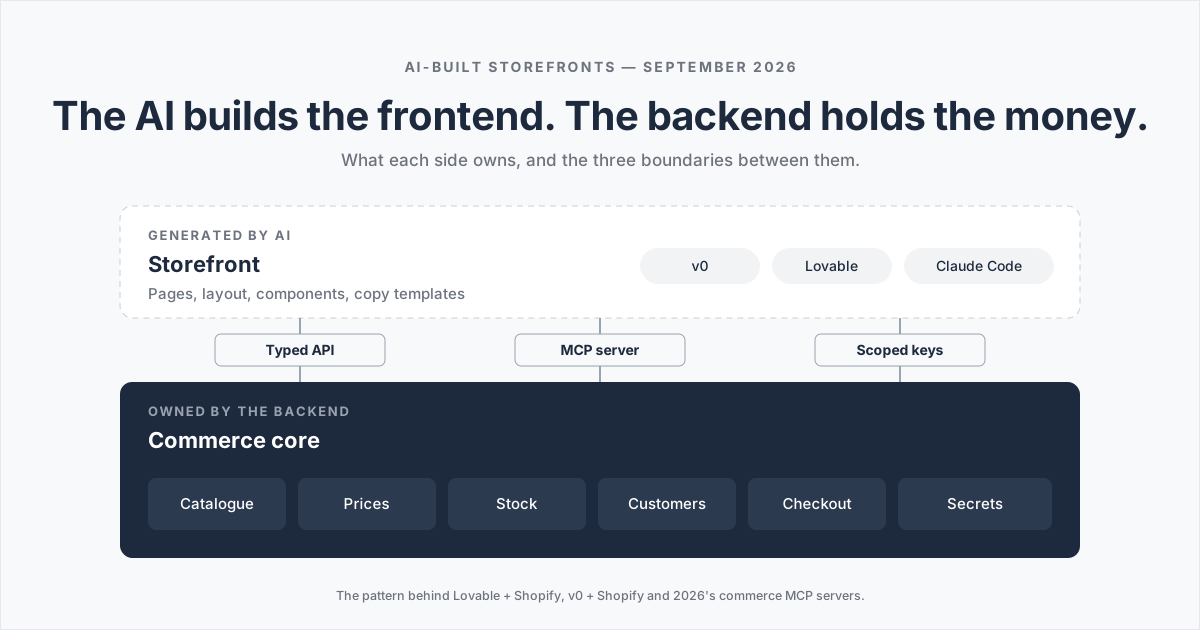
This is the category Omnislice is in, and the reason we're on this list. It's an operations hub that sits under your channels, rather than another storefront to migrate to:
- Catalogue, stock, pricing, orders and customers live in one core that the storefront, marketplaces and POS all read from. There's no sync interval in which two channels can sell the same unit.
- Existing storefronts stay connected. Many teams unify operations first and move storefronts later, or never.
- Any payment processor, with no platform fee on store orders.
- Many stores, one account. Every brand or client store is a project with its own permissions, in one dashboard. That's the model we built for agencies running dozens of client stores.
Best for: multi-brand merchants and the agencies that run them, where the cost is in the stack and the store count, not the storefront. Watch for: we're newer than every other platform on this list, and there are no public case studies yet. Start a free sandbox and test it against your own catalogue before you believe any of this.
Side by side
| Platform | Pricing model | Published price? | Fee on third-party processors | Native B2B | Stores and brands | Effort to move* |
|---|---|---|---|---|---|---|
| Shopify Plus | Flat fee, or % of sales past threshold (capped) | Yes (base) | 0.20% | Yes; B2B basics on all plans since Apr 2026 | 9 expansion stores included | — |
| BigCommerce Performance | Custom quote, from $1,499/mo | Partly | None on Performance | Yes | Multi-storefront | Medium |
| Adobe Commerce | Quote by GMV and AOV | No | None | Strong | Strong multi-site | High |
| Salesforce Commerce Cloud | ~1–3% of GMV (reported) | No | None | Separate B2B product | Strong multi-site | High |
| commercetools | Order-based, quoted | No | None | Via build | Unlimited channels | Very high |
| OroCommerce | Quote by GMV band + hosting | No | None | B2B-first | Multi-org | High |
| Saleor Cloud | Tier + % over GMV cap | Yes | None | Via build | Multi-channel | High (you build it) |
| Medusa | Hosting tiers, no GMV fee | Yes | None | Via build | Multi-store | High (you build it) |
| Omnislice | Seats + project slots | Yes | None | Yes | Built for many stores | Connect first, migrate later |
*Our judgement of the effort for a typical Plus merchant to move, not a vendor figure. It varies widely with catalogue size, integrations and data volume. Real timelines are in the migration section below.
What it costs at $5M, $20M and $50M GMV
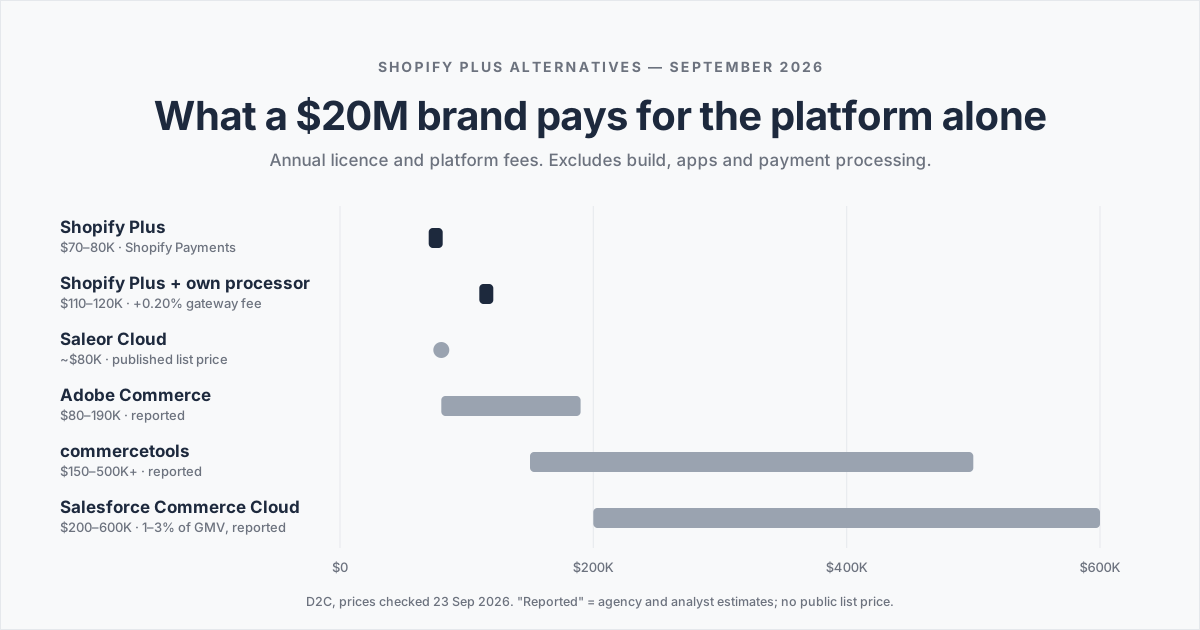
Few comparisons put numbers against specific revenue levels, so here are ours. This table covers platform licence and platform fees only. It excludes build, apps, hosting on self-managed stacks and your processor's own rates. We model a D2C brand. The ranges span the reported one-year and three-year rates.
| Annual platform cost | $5M GMV | $20M GMV | $50M GMV |
|---|---|---|---|
| Shopify Plus, Shopify Payments | $30,000 | $70,000–80,000 | $175,000–200,000 |
| Shopify Plus, third-party processor (+0.20%) | $40,000 | $110,000–120,000 | $275,000–300,000 |
| Saleor Cloud (Volume tier, list price) | $48,000 | $80,000 | $200,000 (Enterprise quoted) |
| Adobe Commerce (reported) | ~$80,000 | $80,000–190,000 | $190,000+ |
| Salesforce Commerce Cloud (1–3%, reported) | $50,000–150,000 | $200,000–600,000 | $500,000–1.5M |
| commercetools (reported) | from ~$40,000 | $150,000–500,000+ | $150,000–500,000+ |
| BigCommerce Performance | quoted, from $18,000 | quoted | quoted |
How we got the Plus rows: at $5M ($417,000 a month) you're below the variable-fee threshold and pay the $2,500 flat fee. At $20M and $50M the reported 0.35–0.40% rate (three-year and one-year terms) applies to monthly sales, which stays well below the $40,000 cap. The third-party row adds 0.20% of GMV. Saleor applies its published 0.4% to monthly GMV above $1M.
Three things stand out:
- Shopify Plus is cheap at the bottom and competitive in the middle. On licence alone, only Saleor and a well-negotiated BigCommerce contract clearly undercut it at $5–20M.
- The third-party processor fee is what moves Plus off the cheap end. It's $100,000 a year at $50M. If you're on Shopify Payments, most of the fee argument for leaving disappears.
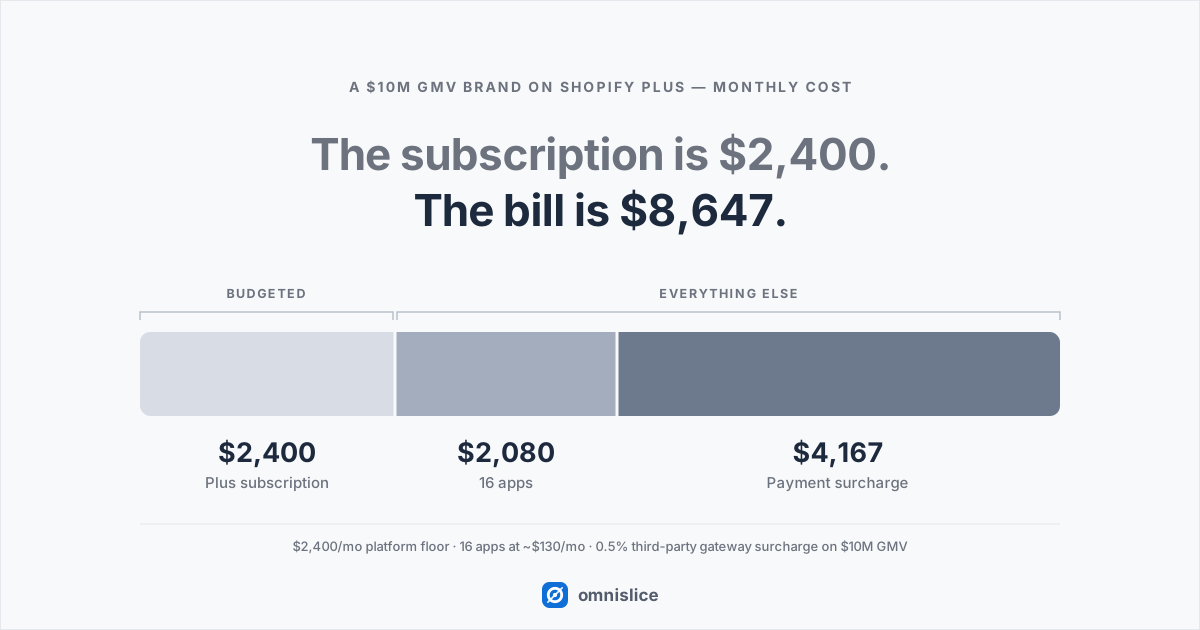
- The licence is the smaller part of the bill. Agency data from 2026 puts the licence at 20–40% of total platform cost once implementation, integrations and apps are counted. For Plus in particular, the app stack is usually the line to look at. We broke that down in the real cost of a Shopify stack.
If you migrate: what actually goes wrong
Published 2026 data from agencies that run replatforms puts a typical mid-market move at $150,000–$300,000 all-in over five to ten months. BigCommerce-to-Plus moves, the simplest SaaS-to-SaaS case, run closer to $30,000–75,000 over three to five months. The risks are consistent across platforms:
- SEO and redirects. Every product, collection and content URL needs a mapped 301. Shopify's forced
/products/and/collections/paths mean your URLs will almost certainly change. Crawl the old site before you start, not after. - Customer passwords. Shopify doesn't export customer passwords. Plan the account re-activation email campaign, and expect a dip in returning-customer logins.
- Order history and IDs. Decide early whether historical orders move as live records or as a read-only archive. Your support team and your accounting integration will both have opinions.
- Integrations. ERP, 3PL and marketplace connectors are the most common reason migrations run late. Inventory them in week one.
- Custom checkout logic. If you've just rebuilt Scripts as Shopify Functions, none of that code travels.
- No rollback plan. Keep the old platform live and read-only for at least a full billing cycle after cutover.
The lowest-risk migrations don't move everything at once. They put a shared operations layer in place first, so catalogue, stock and orders stop depending on the storefront, then move storefronts one by one, reversibly.
A five-question decision framework
- Where does the pain show up: fees, features, or operations? Fees point to BigCommerce, Saleor, or moving to Shopify Payments. Features point to Adobe, Oro or composable. Operations point to fixing the layer underneath.
- What's your GMV in 24 months, not today? Model each platform's fee at that number, not this year's.
- Will you keep your own payment processor? If yes, add Plus's 0.20% to every comparison.
- Who will run it? A composable stack without an engineering team turns into a permanent agency retainer.
- How many stores will you operate? Per-store licences and per-store app bills compound fastest here.
If you answered "operations" to the first question and "more than a few" to the last, look at the layer before you look at the platform.
Frequently asked questions
What is the best alternative to Shopify Plus?
It depends on why you're leaving. BigCommerce is the closest SaaS equivalent. Adobe Commerce and Salesforce Commerce Cloud suit large, complex enterprise catalogues. commercetools suits engineering-led composable builds. OroCommerce suits B2B-first businesses. If the storefront is fine and the operations underneath aren't, an operations hub may beat a full replatform.
Is BigCommerce cheaper than Shopify Plus?
Often, for merchants using a third-party payment processor. BigCommerce Performance starts from $1,499 a month on a custom contract and doesn't charge the Open Payment Provider fee, while Plus adds 0.20% on third-party gateways. For merchants on Shopify Payments the gap is smaller, and the contract's GMV terms decide it.
How much does Shopify Plus cost in 2026?
$2,500 a month on a one-year term or $2,300 on a three-year term. Above a sales threshold, the fee becomes a percentage of sales, reported at 0.35–0.40% for D2C and capped at $40,000 a month. Using a third-party payment gateway adds 0.20% per transaction.
Do I still need Shopify Plus for B2B?
Not necessarily. Since April 2026, company profiles, payment terms, volume pricing and up to three B2B catalogues are available on every Shopify plan. Plus is still needed for unlimited catalogues, per-location catalogue assignment and deposits. Quoting and complex account hierarchies push many B2B businesses beyond both.
How long does it take to migrate off Shopify Plus?
Three to five months for a like-for-like SaaS move with modest integrations. Five to ten months, or longer, for enterprise or composable platforms with ERP integration. Integrations, not product data, are usually what sets the timeline.
Sources
Vendor pages were checked on 23 September 2026. "Reported" figures come from the third-party sources listed here.
- Shopify: Shopify Plus plan (help centre), Shopify Plus pricing, B2B features on non-Plus plans (changelog, April 2026)
- Shopify Plus variable fee (reported): Ringly, BSPK
- BigCommerce: 2026 plan and pricing updates, Commerce.com rebrand announcement
- Adobe: Adobe Commerce as a Cloud Service overview
- Salesforce: Commerce Cloud pricing
- commercetools: Pricing
- Saleor: Pricing · Medusa: Pricing
- Replatforming cost and timelines (reported): Elogic Replatforming Cost Index 2026