Building a Storefront With AI in 2026: What the Backend Has to Do
Summarize this article with


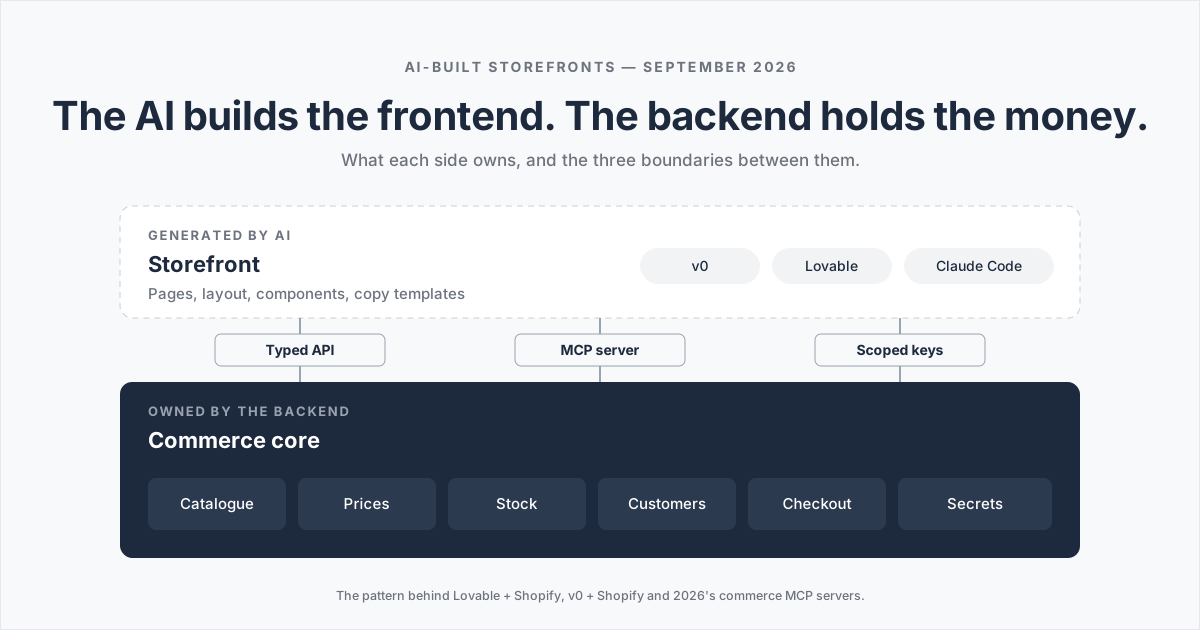
The short answer. AI tools are now good at the part of a store that customers look at, and bad at the part that holds the money. The pattern the whole market has converged on in 2026 is a split: the AI builds the frontend, and a backend it cannot talk its way around owns the catalogue, prices, stock, customers, checkout and keys. Whether an AI-built storefront survives production depends almost entirely on how well that backend is designed for a machine to build against. Below are the nine things it has to provide, and how Omnislice provides them today.
Who wrote this, and why you should read it with that in mind
Omnislice is a commerce backend, so we have an obvious interest in the conclusion that the backend matters. Two things to make that easier to check:
- Every market figure is dated and sourced, and the ones that come from company statements rather than audited numbers say so.
- The Omnislice section describes only what has shipped. We checked each claim against our own code on the day of publishing.
What changed in 2026
A year ago, "build a store with AI" meant a nice-looking prototype with a fake cart. That changed fast.
- The builders got very big. Lovable says it passed $500M in annualised revenue in June 2026, with a million new projects a week (self-reported). Vercel says more than 4 million people have used v0, and relaunched it in February with Git branches, pull requests and deploy-on-merge, calling the result "the world's largest shadow IT problem".
- The builders plugged into commerce backends. Lovable connects to Shopify, which keeps checkout, payments, orders and inventory while Lovable builds the storefront. Since 4 June 2026, v0 and Vercel can create or connect a Shopify store directly, with credentials wired up automatically.
- Agents became shoppers, not just builders. Google and Shopify announced the Universal Commerce Protocol in January 2026, and Shopify's Storefront Catalog MCP server switched to it in April. Commercetools, BigCommerce and Medusa all ship MCP servers of their own.
- Checkout moved back to the merchant. OpenAI launched Instant Checkout in ChatGPT with Stripe in September 2025, and retired it in March 2026, moving ChatGPT back to discovery with purchases completed on the merchant's own site.
The last point is the most telling. The most well-funded attempt to let AI own the whole transaction backed away from checkout within six months. Discovery and presentation are moving to AI; the transaction is staying with systems built to hold it.
Where AI-built frontends break
The data on what goes wrong is now substantial, and it's consistent.
- Exposed data. In 2025 a researcher found 170 of 1,645 Lovable-built apps (10.3%) had databases readable through their public key, because row-level security was missing or wrong. That became CVE-2025-48757. A later scan of 5,600 live vibe-coded apps by Escape found more than 2,000 high-impact vulnerabilities and over 400 exposed secrets.
- Insecure code by default. Veracode's 2025 study found AI-generated code introduced a security flaw in 45% of tasks, and that newer models were no better than older ones.
- Invented dependencies. A USENIX Security 2025 study found about 20% of AI code samples recommended packages that don't exist, and many of those hallucinations repeat on every run. Attackers now register the invented names.
- Agents with too much reach. In July 2025 Replit's agent deleted a production database during a code freeze. Replit's fix was to separate development and production databases by default.
- Invisible to search. Many builders produced single-page apps rendered in the browser, which send crawlers an empty page. AI crawlers generally don't run JavaScript at all. Lovable moved every new project to server rendering in May 2026.
None of these is a frontend bug. Each one is the frontend being trusted with something that should have been the backend's job: enforcing who can read what, holding secrets, deciding what an agent is allowed to change, rendering content in a form machines can read. The better the backend's boundaries, the less the frontend's code quality matters.
The nine things the backend has to provide
This isn't a formal standard. It's what the platforms that make AI-built storefronts work in production have in common, and what's missing from the ones that don't.
1. A typed contract the agent can't guess wrong
Coding agents are good at following a schema and bad at inventing one. A GraphQL schema, an OpenAPI spec or a typed SDK turns "I think the price field is called amount" into a compile error. Shopify now validates AI-written GraphQL and Liquid against its schema inside Claude Code and Cursor. That's the right instinct: catch the hallucination before it ships.
2. A machine interface to the store itself
An agent building a storefront needs to know what's in the store: which content types exist, which fields a product has, what the catalogue looks like. Reading a dashboard is slow and error-prone. An MCP server lets the agent ask directly. The platforms that are furthest along split this in two: one interface for building (docs, schemas) and one for operating (catalogue, stock, orders).
3. Credentials that fail safe
A storefront needs a key that is safe to publish, because it will end up in the browser. Everything else needs keys that are scoped to one store, limited to the permissions the job needs, and revocable. The Lovable incidents were, at bottom, a public key that could reach private data. The backend should make that impossible rather than relying on the generated code to configure it correctly.
4. A place to break things
Agents make mistakes, and some of those mistakes are writes. You want a way to preview a bulk change before applying it, and a store or environment that isn't the one taking real orders. Vercel's Shopify integration creates stores password-protected and unable to take payment until a human claims them. That's the pattern: the agent can build freely, and a person decides when it's real.
5. A checkout the AI never writes
Payments are where generated code is most dangerous and least necessary. The backend should own payment intent creation, amount calculation, tax, discounts and order placement. The frontend's job is to collect card details through the payment provider's own components and hand back a result. Every successful builder integration in 2026 works this way.
6. Content as structured data
If product descriptions, landing pages and navigation live in the backend as typed fields, an agent can build templates against them and a merchant can change the words without regenerating code. If content lives in the generated components, every copy change becomes a code change, and every code change is a chance for the AI to break something else.
7. Images through a CDN that resizes on request
Generated frontends are often the worst offenders for page weight. A CDN that resizes and converts formats through URL parameters lets the agent write ?w=800&auto=format and get the right image, instead of shipping a 4 MB product photo to a phone.
8. Data that renders on the server
The frontend should be able to fetch everything it needs at build or request time, on the server, so pages arrive as HTML. That's a backend property as much as a frontend one: the API has to be usable server-to-server, fast enough to call during rendering, and complete enough that the page doesn't need a second round of browser requests to show a price.
9. One source of truth, and a way to hear when it changes
A generated storefront that keeps its own copy of prices or stock will drift. The storefront should read from the same catalogue that the marketplaces, POS and back office use, and the backend should tell the frontend when something changes, so a rebuild or cache purge happens without anyone remembering to trigger it. We know of no published study measuring price and stock drift in AI-built stores, so treat this one as reasoning rather than data. It's the oldest problem in multichannel commerce, and AI makes it easier to create more channels.
Where Omnislice stands
We checked each of the nine against our own code on 23 September 2026. Here's what it provides today.
- A GraphQL storefront API with a public, per-storefront key. Products, content documents, customer accounts, cart, promotions, delivery options, checkout and orders. The key identifies the storefront, not the merchant, so it's safe in a browser. It works server-to-server, so it suits server-rendered frameworks.
- Typed clients. TypeScript clients for the storefront API (a GraphQL core, React hooks and web components), with their queries checked in CI against the server's schema. They're alpha, version 0.0.x, and not yet published to npm.
- An MCP server, launched September 2026. Thirteen tools that let Claude, Cursor or any MCP client read a project's structure (
store_overview,describe_models), search and read the catalogue and stock (search_products,get_product,check_stock), read orders and customers with personal data trimmed, and make catalogue and setup changes. Each project connects with a scoped key or through OAuth sign-in. - Guardrails on what the agent can reach. Keys are bound to one project and carry explicit scopes. Order and customer access has to be granted on purpose; nothing implies it. Keys issued through OAuth can never read orders or customers at all, and signing in grants nothing until a project owner approves it in the dashboard. Refunds, order changes, billing, payment settings and deployments aren't available over MCP by design.
- Preview before you write. Store setup can be exported as a Blueprint, and
blueprint_dry_runvalidates a proposed change and shows the diff beforeblueprint_applytouches anything. - Structured content. Content models with typed fields (text, rich text, images, galleries, dates, sets), automatic slugs and per-field translations, served through the same API as products.
- Image CDN. Product and content images are served through Imgix, so a frontend can resize and convert them by URL parameter.
- Checkout the frontend doesn't compute. The backend creates the Stripe payment on the merchant's own connected account and calculates the amount. The storefront collects card details with Stripe's own components and places the order. Local methods (MB WAY, Multibanco) and B2B invoice terms go through the same flow.
- One catalogue behind every channel. Connectors such as Shopify and Medusa feed the same catalogue the storefront API reads, so a generated storefront isn't a separate copy of the store.
- Rebuild hooks. A storefront can have deploy targets (Vercel, Netlify, Cloudflare Pages, Render, Coolify or any webhook) with every run logged.
How to build one on Omnislice today
If you want to try the pattern now, this is the path of least resistance with what's shipped:
- Model the store with the agent, not in the code. Connect Claude or Cursor to your project over MCP. Have it describe your content models and catalogue, draft a Blueprint for anything missing, and dry-run it before applying.
- Generate the frontend against the schema. Point your coding agent at the storefront GraphQL API and have it fetch on the server. Server-rendered frameworks such as Next.js, Astro or TanStack Start avoid the empty-page problem entirely.
- Leave checkout to the backend. Call
createCheckoutSession, render Stripe's payment element with the returned secret, then callplaceOrder. Don't let the agent compute totals. - Wire a deploy target. Add your host's deploy hook to the storefront so a rebuild is one click, and plan for it to become automatic.
- Review what the agent wrote. Especially anything that touches keys, cookies or customer data. The backend limits the blast radius, but it doesn't make generated code correct.
Frequently asked questions
Can I build a real ecommerce store with an AI builder like Lovable or v0?
Yes, if the AI builds the storefront and a commerce backend handles the catalogue, stock, checkout and payments. Lovable and v0 both connect to Shopify for exactly that reason. Stores where the AI also generated the database and payment logic are where most of the published security incidents came from.
What does a backend need to support AI-generated frontends?
A typed API or schema, a machine interface such as an MCP server, credentials split between a publishable storefront key and scoped private keys, a safe place to test writes, checkout the backend controls, content stored as structured data, an image CDN, an API usable during server rendering, and one catalogue with change notifications.
Is a vibe-coded storefront bad for SEO?
It can be. Apps rendered only in the browser send search and AI crawlers an empty page. Build with a framework that renders on the server, fetch catalogue data on the server, and make sure your backend stores SEO fields as content rather than hard-coding them.
Should an AI agent have write access to my store?
Only scoped, previewable write access to things you can undo, such as catalogue data and store setup. Keep orders, refunds, payments and customer personal data out of reach unless there's a specific reason, and require a human to approve access in the first place.
Does Omnislice have an MCP server?
Yes, since September 2026. It has thirteen tools for reading a project's structure, catalogue, stock, orders and customers, and for making catalogue and setup changes with a dry run first. It connects with a scoped project key or with OAuth sign-in that a project owner must approve.
Sources
Checked on 23 September 2026. "Self-reported" means a company statement, not audited figures.
- Lovable revenue (self-reported): TechCrunch, 9 June 2026 · Lovable + Shopify: Lovable docs · Lovable server rendering: Lovable SEO docs
- v0: Introducing the new v0 (Vercel) · Build and deploy Shopify storefronts on Vercel (changelog, June 2026) · Shopify help: v0 by Vercel
- Shopify: AI commerce at scale (UCP) · Storefront Catalog MCP now implements UCP · Shopify AI Toolkit
- Other MCP servers: commercetools Commerce MCP · BigCommerce Storefront MCP · Medusa
- Checkout: Stripe and OpenAI Instant Checkout, Sept 2025 · CNBC, 24 March 2026 · Google AP2
- Security: CVE-2025-48757 (Matt Palmer) · Escape: state of security of vibe-coded apps · Veracode 2025 GenAI Code Security Report · Snyk on slopsquatting · The Register on the Replit incident